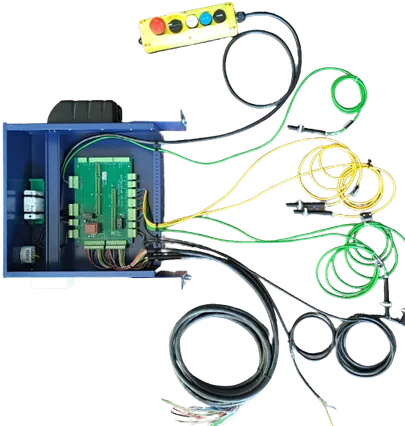
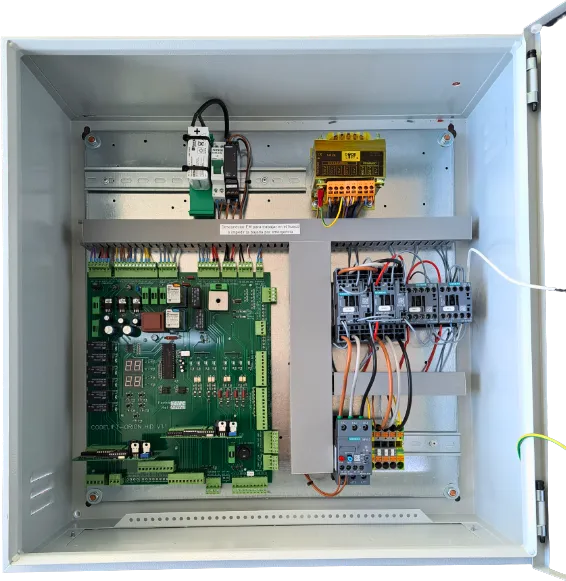
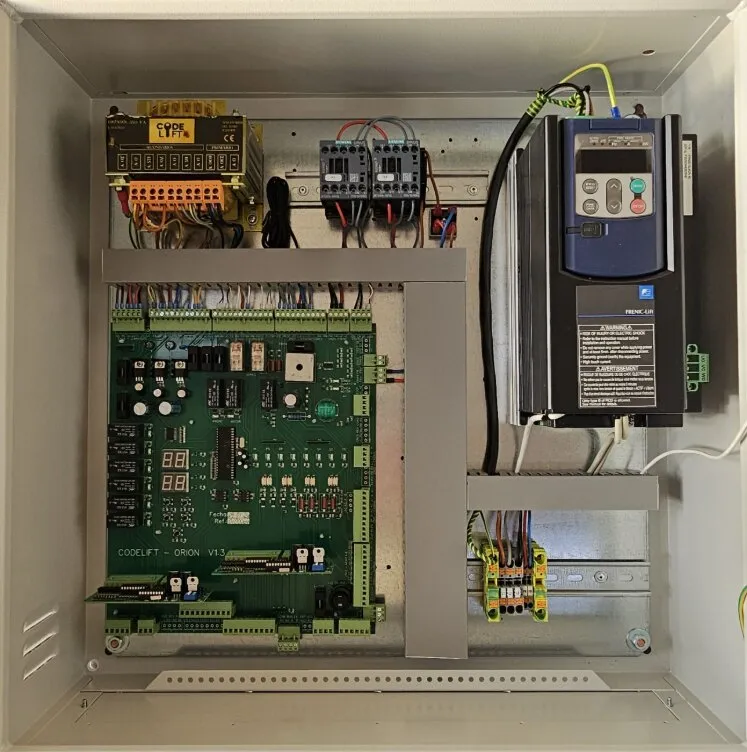
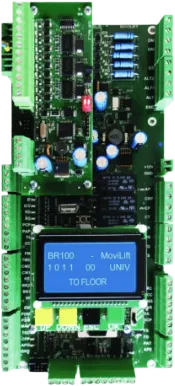
These installations resemble each other more than their names suggest. Two, three or four stops, a short rise, intermittent use and, almost always, a technical space that either does not exist or is occupied by something else. The controller they need is a unit sized for that profile: few stops, a low-power drive and an enclosure that fits where there is room. Not a building panel with things taken out.
The usual drive is hydraulic or traction with a low-power inverter. On hydraulic, the panel governs pump start-up and emergency lowering, which in a private home is also the procedure someone with no technical training has to be able to carry out. On inverter-driven traction, the range starts at 4 kW (10 A), which is the rating most of these installations work at.
Format rules. Where the room will not take a full cabinet, the same control scope is delivered in a box, pre-wired and with its inspection station, so commissioning does not force anyone to redo wiring in a space that is by definition awkward. If the constraint on the project is the free dimensions, that is the first figure to put on the table.
Standards do not drop a level because the equipment is small. The panels comply with EN 81-20 and EN 81-50, Directive 2014/33/EU on lifts and 2014/30/EU on electromagnetic compatibility, and push-button accessibility follows EN 81-70 with Braille marking and illuminated call acknowledgement, on a two- or three-button station as much as anywhere else. A goods lift in a shop with public access does not get a different criterion from a passenger elevator.
Two honest caveats. Codelift does not sell a closed goods-lift or home-lift product: what exists are configurable controllers from the catalogue that cover this installation profile. And where the apparatus is a lifting platform or a goods-only lift not accessible to people, the applicable regulatory framework may not be EN 81-20/-50, so the first step in quoting is establishing which standard the work falls under.