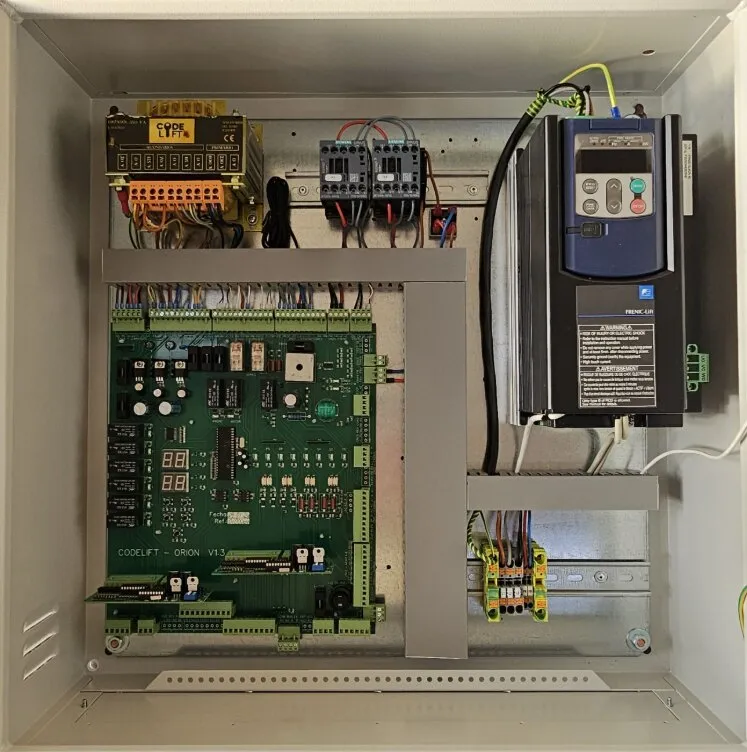
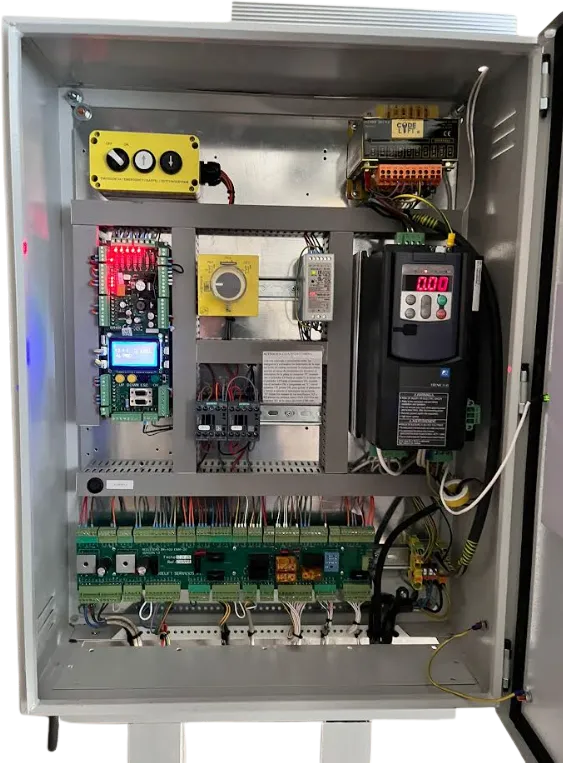
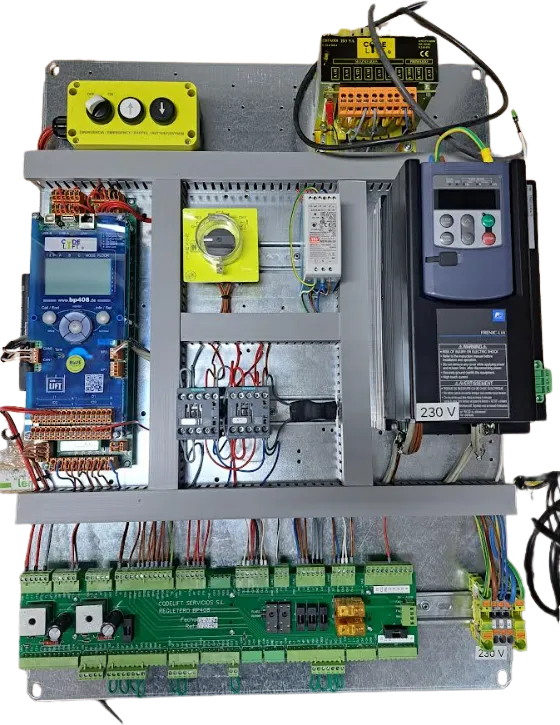
The frequency inverter switches IGBT transistors to build a three-phase supply that varies in voltage and frequency. With that it regulates motor speed while holding torque constant at low speed too, which is exactly what a two-speed controller cannot do: where there used to be a perceptible step on entering the floor level, there is now a ramp.
Control is vector-based: the regulation loop closes on the current the motor draws, and out of that come smooth starts, speed changes and stops, with ±1 cm levelling accuracy regardless of car load. For the passenger that is less noise and less vibration on every trip; for the building, an elevator that does not announce its own controller.
The consequences are mechanical and electrical at once. It extends the life of motor, gearbox and brake, because the shock of starting and braking disappears; it improves the power factor; and it cuts inrush current from five times to twice rated current, with the energy saving that follows and with less demand on the building's supply — which in refurbishment is often the real limit of the project.
Across the Codelift range the reference inverter is the FUJI Lift-2, from 4 kW (10 A) to 41 kW (91 A), covering everything from a home lift to a bank in a commercial building. On the BP-408 platform, control and inverter talk over DCP on RS-485: the speed reference travels on the bus instead of through on/off contacts, which cuts the wiring between the two units and allows a finer travel profile, with acceleration and braking set by parameter.
The main board is programmed as universal, down-collective or full-collective control, and the group algorithm adapts without an additional controller sitting above it. Inverter rating, machine type, number of floors and rated speed are fixed against the specific installation: the machine's nameplate and the number of floors are enough to close the sizing.