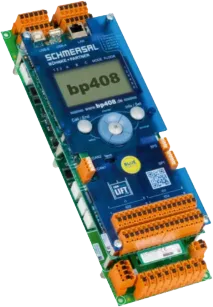
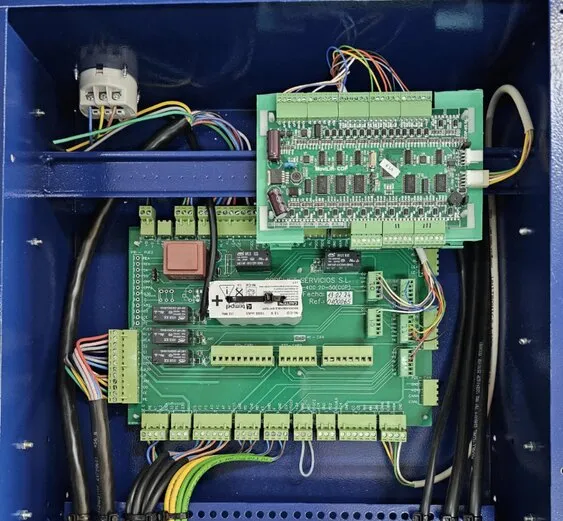
A machine-room-less lift does not remove the controller, it relocates it. Everything a conventional installation solved with space — wiring slack, ventilation, standing access from the front — has to be solved here with format. Which is why the type is not covered by squeezing a conventional panel into a smaller box, but with platforms designed from the start to work without a plant room.
The first consequence is wiring. With no machine room, every extra terminal is a terminal someone will later have to maintain hanging off the shaft or reaching in from the landing. Controllers of this type run in serial mode — 2-wire RS-485 in the ORIÓN architecture, fully serial car-to-landing on the BR-400 — so signals that are neither critical nor safety-related travel on the bus, and travelling cable and terminal count drop in proportion to the rise.
The second is rescue. EN 81-20 starts from the position that, where no machine room exists, the means of rescue and inspection must be reachable from a safe area. Cabinets in this range carry a rescue station operable from the landing, and the safety circuit is monitored by the EN 81-20/-50 module the board itself integrates, not by an accessory bolted onto the assembly.
The third is positioning. Without a machine room the convenient mechanical reference point disappears, so the BP-408 platform supports absolute positioning with a linear or rotary encoder and safe position evaluation (PSU), and the BR-400 manages the encoder absolutely. Both serve roped and hydraulic installations alike.
Every unit of this type leaves the Cornellà de Llobregat plant pre-wired and connectorised with WAGO plug-in connectors, harnesses labelled one by one: in an installation without a machine room, wiring at the shaft is precisely the work nobody wants. The final build depends on the number of floors, the drive type, the door operator and the applicable standards, so the type narrows the project without closing it: the quote is made against the lift's own data.